Psychology
Why Most Productivity Advice Never Works for People Like Us
I’ve dedicated a huge part of my life to trying to become more productive. It started with the usual advice: wake up at 5 a.m., go to the gym, take various supplements, optimize your morning routine. For a while I believed that if I just followed these simple rules, my life would transform.
Eventually I realized something important: the simpler the advice, the less it usually works.
Simple advice spreads so well precisely because it feels like a great deal — small effort for potentially huge results. People love that. But reality is much harsher.
Yes, sport and a stable daily routine do improve life. But what do you do when you’re already training, sleeping relatively well, and still don’t have the energy to do the things that actually matter? Or when waves of apathy and depression hit you out of nowhere and destroy all your good habits in a few days?
As for supplements — I regret every dollar I spent on them. Most of it is pseudoscientific marketing with unclear ingredients and potential side effects.
Over the years I went deeper — into neuroscience, behavioral psychology, and how our brain actually works. I wanted to understand what we can realistically change and what we cannot.
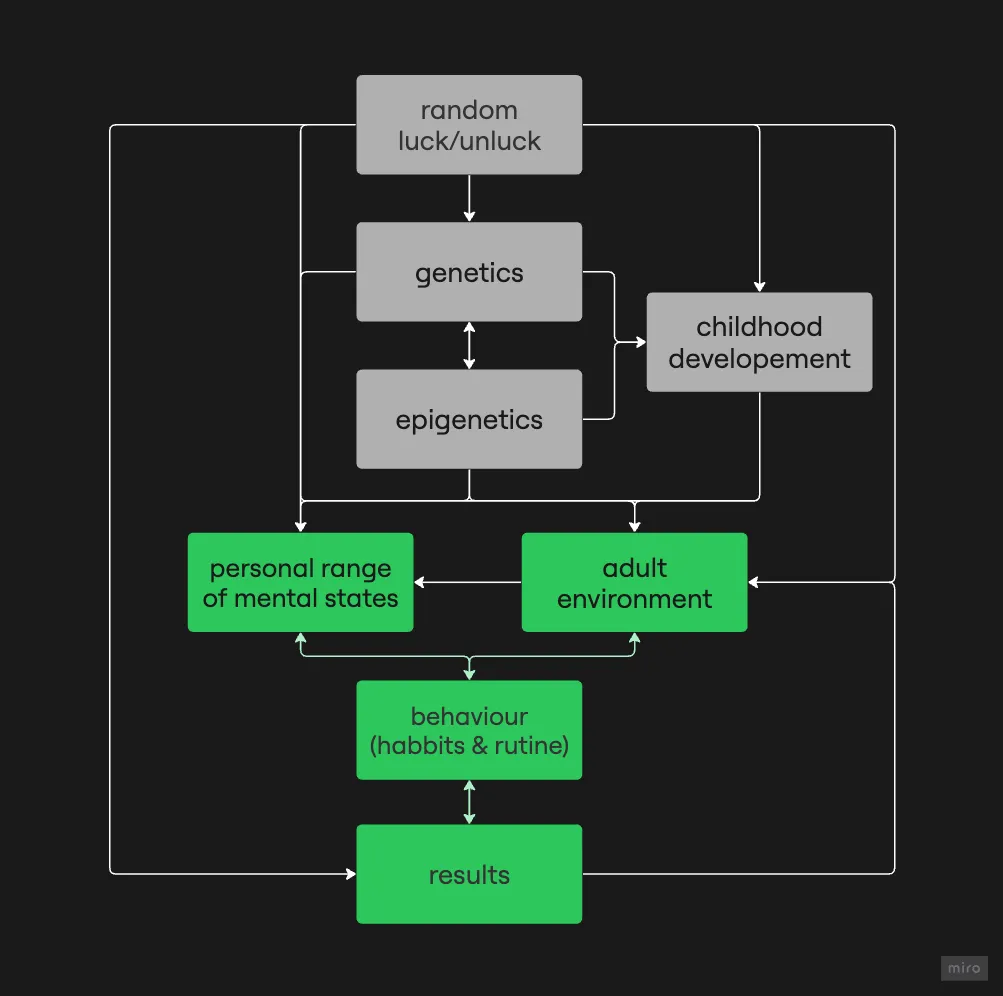
Here’s the framework I eventually came to:
A huge part of our lives and their outcomes depends on plain old luck. According to some interpretations, everything depends on it, but we couldn’t possibly live in a world where we accepted absolute determinism, so we’ll hold on to at least some sense of agency to keep from going mad.
Genes, prenatal development, childhood environment, early traumas, education, nutrition — all of this shapes the “corridor of possibilities” we have to work with.
And it is only as we become adults that we generally begin — though by no means always, and certainly not right away — to become aware of our habits, their long-term implications and consequences, their strengths and weaknesses, and then our ability to influence them or at least take them into account in our own model of reality.
By this time, we are living in a certain environment that shapes and anchors a huge part of our current behavior, established routines, and character. Genetics and luck also continue to exert their influence on our lives, but we gain a small lever for minor changes that, over time, can lead to more significant changes: we can shape the environment, which, in turn, will shape us in the future.
I’ve highlighted the area that most of us can influence in some way in green (with rare exceptions, this applies to everyone). If you’re a parent, you can influence each of the blocks in the diagram of your child’s life, except for luck (the only real challenge today is genetics, but even gene editing and control of embryos is already becoming available in some countries for additional payment). You are, in a sense, a factor in your children’s luck (or unluck).
This is why advice from a genetically gifted athlete or a hyper-disciplined guru often fails ordinary people. Their recommendations come from a completely different starting point. What works for someone who naturally has high energy and low impulsivity can be completely unrealistic for someone dealing with depression, ADHD tendencies, or years of bad habits.
The uncomfortable truth is that we cannot become anyone we want. Choji cannot become Naruto (iykwim). We can only move within our own corridor of possibilities. The good news? We can become significantly better than we are now. The bad news? We probably won’t become as good as that guy on Instagram who seems to have unlimited discipline — because his corridor is simply wider.
Real change happens not through heroic willpower, but through small, sustainable adjustments to our environment that gradually shift our default states. This process is slow, often invisible, and requires a lot of self-compassion.
Stop scrolling. Start living.
Join the 42h waitlist to be part of the first public run.